Shadow Work Exercises: How to Actually Collapse the Pattern (Not Just Cope With It)
Shadow Work Exercises: How to Actually Collapse the Pattern (Not Just Cope With It)
You’ve done the journaling. You’ve sat with your triggers. You’ve said the affirmations, hired the therapist, read the books, probably bought a crystal or two. And yet here you are again. Same pattern, different person. Same feeling, new situation. Same you, wondering what is actually wrong with you.
Nothing is wrong with you. But something is definitely still running.
Here’s what nobody tells you: most shadow work isn’t actually finishing the job. It’s helping you cope. It’s helping you manage. It’s giving you increasingly sophisticated tools to work around the pattern while the pattern itself sits in the background going absolutely unbothered.
That’s not a willpower problem. It’s not a commitment problem. It’s a neurology problem. And once you understand what’s actually happening in your brain, the whole thing starts to make a lot more sense.
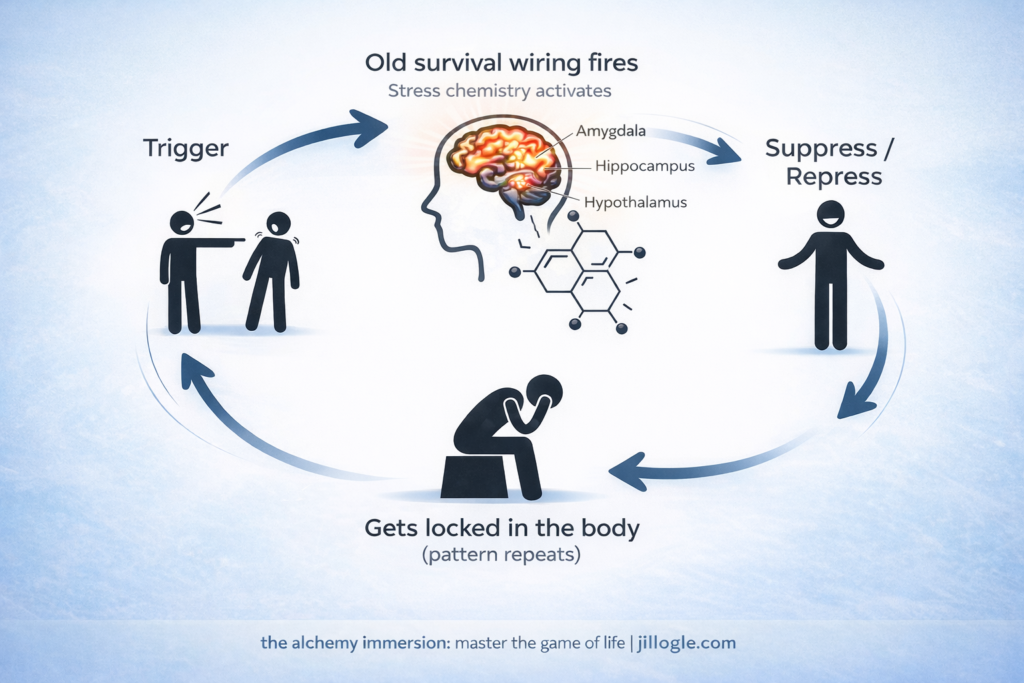
When something overwhelming happens, especially in childhood, your nervous system goes into fight or flight. In that state your brain’s rational processing centers go essentially offline. You can’t fully feel it, integrate it, or complete it. So the experience doesn’t get filed away as a finished memory. It gets frozen. Stored as an active unresolved event still living in your nervous system, still on high alert, still waiting for a resolution that never came.
Years later, something happens that reminds your brain of that original moment and it fires the same response. Same emotions. Same shutdown. Same behavior. Not because you’re broken, but because your nervous system is doing exactly what it was designed to do: protect you from something it never got to finish processing.
That’s your shadow. Not a character flaw. Not proof that you’re too much or not enough. An incomplete event in your neurology that never got to close.
What Is Shadow Work?
The term comes from Carl Jung, the Swiss psychiatrist who proposed that every person carries a “shadow” — the parts of themselves they’ve pushed out of conscious awareness. The feelings that weren’t safe to express. The needs that went unmet. The versions of yourself you learned to hide because they were too much, too messy, or frankly too inconvenient for the people around you.
Basically, the parts you shoved in a box, taped shut, and threw in the back of the mental closet. Except the box didn’t stay closed. It never does.
Think of it this way. Every incomplete emotional event is like an app you accidentally left open on your phone. You didn’t choose to open it. You definitely forgot it was there. But it’s running in the background, using your processing power, draining your battery, and quietly influencing everything else you’re trying to do. And you can’t even see it on your screen. You just notice that everything feels slower, heavier, harder than it should.
Now imagine you’ve been doing that since you were four years old.
You’re not running one forgotten app. You’re running 47 of them. And they’re not just sitting there quietly. They’re deciding what you believe you’re worth. How much you allow yourself to have. Who you trust. How you respond when someone gets too close or things start going too well. They are the unconscious controllers steering your thoughts, your behavior, your relationships, your ceiling. And you didn’t even know they had the wheel.
Most people’s solution is to download a better app. New affirmations, new habits, new morning routines stacked on top of the same overloaded system. The apps are still open. Still running. Still quietly making every decision that matters.
That’s the core problem with most shadow work. Awareness is a starting point, not a finish line. You can know exactly where a pattern came from, write twelve journal pages about it, and still be completely unable to stop it. Ask anyone who’s spent three years in therapy going “yes I totally understand why I do this” and then absolutely continues to do it.
Real shadow work doesn’t just shine a light on the apps. It closes them. At the root. So the pattern has nothing left to run on.

Why Most Shadow Work Doesn’t Work
Most shadow work operates on the assumption that if you understand something deeply enough, it will change. So you journal about it. You talk about it. You trace it back to your childhood, name the wound, identify the belief. And you feel better for a while. Sometimes a lot better.
But then life happens. Someone says the wrong thing, or the right thing in the wrong tone, and you’re right back there. Same charge. Same reaction. Same shame spiral afterward wondering why you can’t just be further along by now.
Here’s why.
Understanding a pattern and completing a pattern are two completely different things. When a painful event occurs and your nervous system goes into fight or flight, the experience gets encoded — saved — with the perception you had in that moment. A child’s perception. A frightened perception. A perception that was doing its best with the information and the emotional capacity available at the time.
That perception gets locked in at the moment of encoding. And every tool that works at the level of the present — affirmations, journaling, mindset work, even most therapy — is trying to overwrite a file that was saved incorrectly at the source. You’re not fixing the corrupted file. You’re just creating a new one on top of it. And the old one keeps loading anyway.
It’s like trying to fix a typo in a document by printing a new version and stapling it to the front. The original is still in there. Still the thing your brain reaches for under pressure.
This is why you can do years of incredible, sincere, courageous personal development work and still find yourself blindsided by the same pattern in a new situation. It’s not because you haven’t worked hard enough. It’s because you’ve been working at the wrong level.
The only thing that actually closes the app is going back to the moment it was opened — the moment the experience was encoded — and correcting the perception there. At the root. Where the file was originally saved wrong.
That’s what makes the NeuroCognitive Rebalancing™ different from everything else you’ve tried.
Signs Your Shadow Is Running the Show
Before we get into the exercises, it helps to know what you’re actually looking for. Your shadow doesn’t announce itself. It’s subtle, familiar, and usually disguised as just the way you are.
Here are the signs:
You react bigger than the situation deserves. Someone cancels plans and you’re fine on the surface but furious underneath. Your partner uses a certain tone and something in you completely shuts down. The reaction feels automatic, disproportionate, and embarrassing in hindsight. That’s not you overreacting. That’s an open app recognizing a familiar pattern and firing.
You keep recreating the same dynamic with different people. Different partner, same relationship. Different boss, same dynamic. Different friend group, same role you always end up playing. If the cast keeps changing but the story stays the same, you’re not unlucky. You’re running a program.
You self-sabotage right when things get good. The promotion comes through and suddenly you’re picking fights at home. The relationship finally feels safe and you find something wrong with it. Things start going well and some part of you finds a way to level it back down to what feels familiar. Your nervous system has a ceiling and it will enforce it.
Your inner critic sounds like a specific person. Not just a vague negative voice. An actual person. With their actual cadence. Because it is — it’s an encoded perception from a moment when someone else’s voice got saved as your own truth.
You’re exhausted by your own patterns. You know what you’re doing. You can see it happening in real time. And you still can’t stop it. That particular combination of clarity and helplessness is one of the most frustrating human experiences there is. And it’s one of the clearest signs that the work needs to happen at a deeper level than awareness.
Shadow Work Exercises
These exercises will help you begin to identify and work with your shadow. They are genuinely useful as a starting point. What they won’t do is close the apps completely — for that, the perceptual correction needs to happen at the moment of encoding, which is deeper work. But this is how you start to see what’s running.
1. The Trigger Inventory For one week, every time you have a reaction that feels bigger than the situation or leaves you feeling ashamed, write it down. Not an essay — just: what happened, what you felt, and what it reminded you of. You’re not analyzing yet. You’re just cataloguing. You’re finding out which apps are open.
2. The Projection Mirror Write down three traits in other people that genuinely irritate or enrage you. Now ask yourself honestly: where do I do that? Not identically — your version might look completely different on the surface. But somewhere in there, in some context, some version of that trait lives in you too. What you can’t stand in others is almost always something unintegrated in yourself.
3. The Earliest Memory Pick a pattern you keep repeating. Now ask: when did I first feel this? Go as far back as you can. You’re looking for the original file. The first time this got encoded. You don’t need to do anything with it yet — just finding it is significant.
4. The Charged Relationship Letter Pick someone you have a strong emotional charge toward — resentment, guilt, grief, anger, or even intense admiration. Write them a letter you’ll never send. Say everything. Then read it back and ask: what does this tell me about what I’m still carrying?
5. The Identity Audit Finish these sentences without thinking too hard: I am someone who always… I am someone who never… People like me don’t… I could never… These completions are your encoded beliefs about who you are. Most of them were written by a much younger version of you in a moment of pain. They’re worth examining.
What Real Transformation Looks Like
Real transformation isn’t waking up one day and never getting triggered again. It’s subtler than that and more profound.
It’s noticing that the thing that used to send you into a spiral for three days now passes through in an afternoon. Then an hour. Then it just doesn’t land the same way anymore. Not because you’ve learned to manage it better. Because the charge that was feeding it is gone.
It’s finding yourself in a situation that would have historically derailed you completely and realizing you responded differently. Not because you remembered to use a tool. Because the pattern didn’t fire. Because the app is closed.
It’s the relationship dynamic that kept repeating finally stopping — not because you found a better partner or a better strategy, but because the thing inside you that was creating it isn’t there anymore.
It’s having capacity you didn’t have before. Mental space. Emotional bandwidth. Energy that was previously tied up managing 47 background apps now actually available to you.
And it’s an identity shift that happens quietly but completely. The beliefs that were encoded in those original moments — I’m too much, I’m not enough, I’m not safe, I’m not worthy — stop feeling like the truth. Not because you’ve been repeating the opposite every morning in the mirror. Because the moment they were created has been corrected at the source.
This is what the NeuroCognitive Rebalancing™ does. It goes back to the moment your brain saved the experience wrong, corrects the perception at the point of encoding, and allows your nervous system to finally complete what it never got to finish.
No daily maintenance. No rituals to keep up with. No affirmations to hold the whole thing together. The pattern collapses because it has nothing left to run on.
Work With Jill
If you’ve read this far, something in here landed for you. Maybe it’s the first time the pattern actually makes sense. Maybe you’re feeling that specific combination of relief and “oh god how much time have I lost.” Both are completely valid.
This is the work I do with people 1:1. Not teaching you to manage your patterns. Not giving you more tools to add to the pile. Going in, finding the root, and doing the perceptual correction at the moment of encoding so the pattern genuinely has nothing left to run on.
If you’re done with coping and ready to actually close the apps, I’d love to talk.